| Cygnet Rowing Club |
| Illustrated History |
At Hammersmith
By 1904 the Club had outgrown its existing premises at Aylings. There being no other suitable premises at Putney, an offer was finally accepted from J.Biffen of Hammersmith for the use of six boats and a dressing room at a cost of £40 a year. The decision to move to Hammersmith was not taken lightly and appears to have been the subject of several heated meetings in the old Duke's Head. An alternative tender from Tom Green's Boathouse, which stood adjacent to Barnes Bridge and almost on the site of the present Chiswick Boathouse, was turned down because it was too inaccessible.
The Club took up residence at Biffen's Boathouse in late 1904. Soon afterwards the minutes of committee meetings show that a new `watering hole' had been found for these occasions, namely the Rutland Arms Hotel, immediately next door to Biffen's. The years preceding the 1914-18 war followed a, by now, time honoured programme of club events. However, the Club also began to travel further afield to provincial regattas like Bedford, Leicester and Nottingham, where it participated at Junior and `Maiden' (Novice) level. This break away from in-house club rowing marked the beginning of Cygnet's association with the ARA and in 1908 relations with the NARA were severed for good.
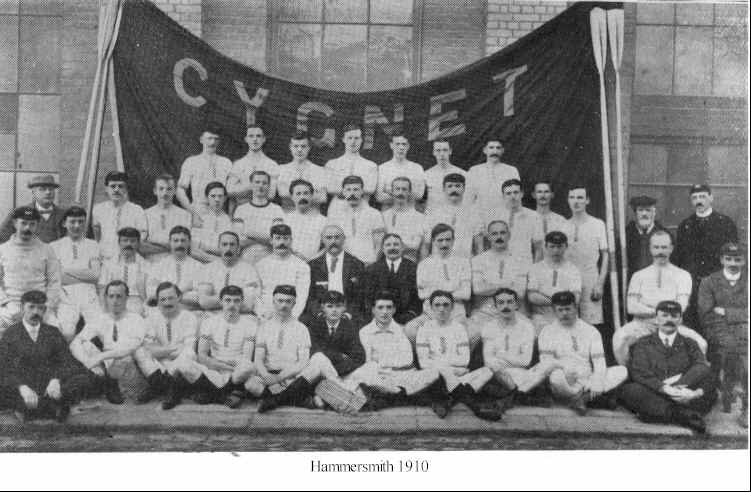
A notable feature of 1910 was the taking of an official Club photograph which is shown here. It depicts 45 members, many in rowing attire, set against the backdrop of the Club flag. Those men standing in the back row, on wooden forms, include a very young Dan Gallagher. In the next row can be seen Jim Harris and in the front row, Arthur Brittan. Those wearing dark suits or blazers are believed to have been the captaincy and coaching committee.
Coming of age
In 1911 the Club celebrated its 21st anniversary with a grand reunion at the Club camp on Hamhaugh Island, Shepperton. A measure of the Club's growing confidence was the decision to apply for membership of the ARA in 1913. This application was refused, for reasons unspecified, while another in 1914 was overtaken by the outbreak of the First World War. During the war the Club was put on a care and maintenance basis and entrusted to older `swans' like Wally Wheldal and the Easley brothers. One of the few new recruits in those lean times was Otto Young who joined in 1915 and is still a member today.
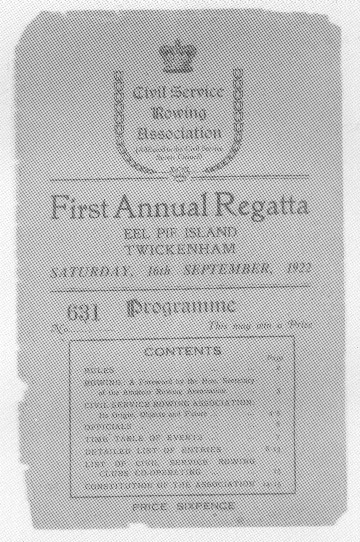
The Club regatta held in August 1920 marked the beginning of Cygnet's return to normal after the First World War. This regatta attracted so many entries that preliminary heats had to be held on the day before the event. The early 1920s were a time of great evolution for Cygnet and Civil Service rowing. The Civil Service Rowing Association was formed in 1922 and later that year the first Civil Service Regatta was held in which Cygnet figured prominently. A copy of the front page of the programme for this regatta is shown here.
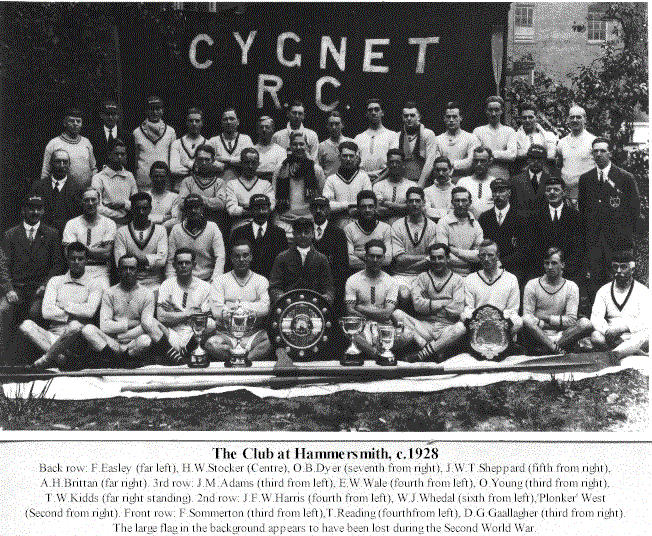
Cygnet was particularly strong in the early 1920s, participating in provincial regattas and invitation events held by other rowing clubs such as Auriol & Kensington. It was not surprising therefore that the Club should again apply for affiliation to the ARA, which was granted in July 1923. In this same year, Cambridge University Boat Club accepted Cygnet's offer of a club VIII to act as a pacing crew in the mornings immediately prior to the University Boat Race.
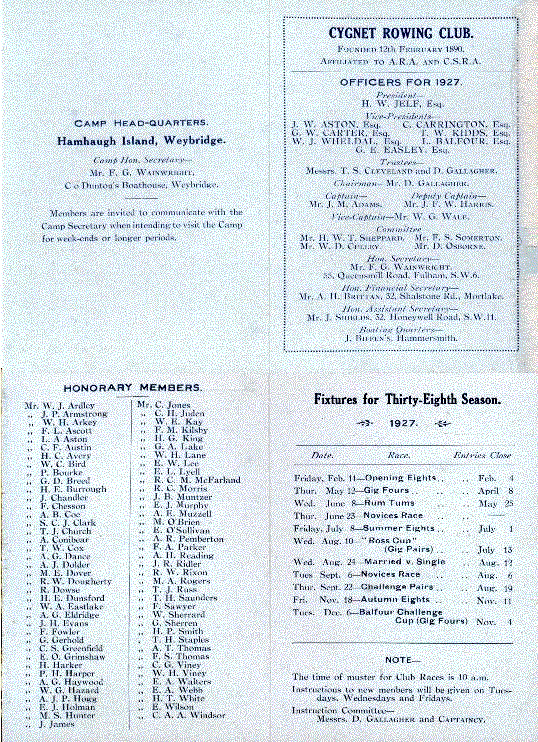
The Club participated in the first Hammersmith Regatta in May 1924 and in the very first Head of the River Race held in December 1926, when it finished 14th out of 21 crews. This decade also saw such additions to the Club's racing programme as the Ross Pairs, the Challenge Pairs, the Balfour Fours and the Clarkson Shield (sculls), all of which are still competed for today. One novel event, which is no longer competed for, was Married v Single.
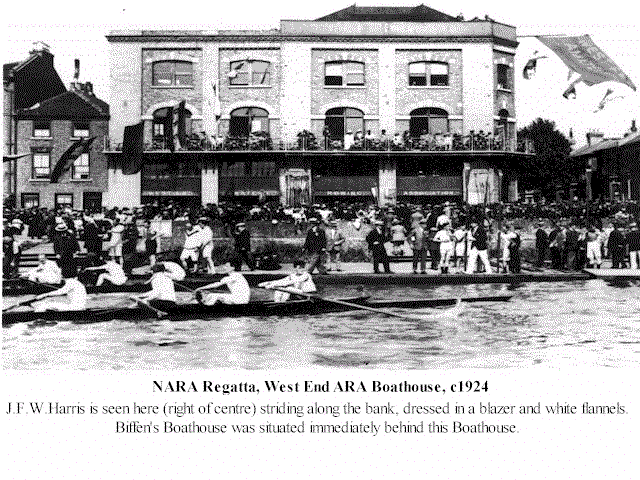
In 1926, the Club moved to the West End ARA Boathouse pictured above. However, this arrangement proved to be short-lived and 1929 found the Club at a low ebb, making do with cramped quarters in the Rutland Hotel. So, as the 1920s reached a close, the Club prepared to move upriver for the second time in its history to the new Civil Service Boathouse at Chiswick. Thankfully, this move seems to have caused less anguish than that from Putney and Cygnet took its grand farewell of Hammersmith at a supper in the Rutland in October 1930.