| Cygnet Rowing Club |
| Illustrated History |
The Post War Years (1945-70)
The late 1940s were a time of rebuilding again after the Second World War. Membership was broadened by the decision of the Post Office Savings Bank to join forces with Cygnet in 1947 and soon the Club was recruiting from all Civil Service departments. The times of outings were also altered from mornings to evenings and weekends.
By the early 1950s the nature of the sport was beginning to change. Weight-training and cross-country running began to be absorbed into the Club's winter training programme. Cygnet was also fortunate enough to have the use of indoor rowing tanks at Quintin and Thames. So, once again, Cygnet began to concentrate on open competition in VIIIs at upriver regattas.
Victory revisited
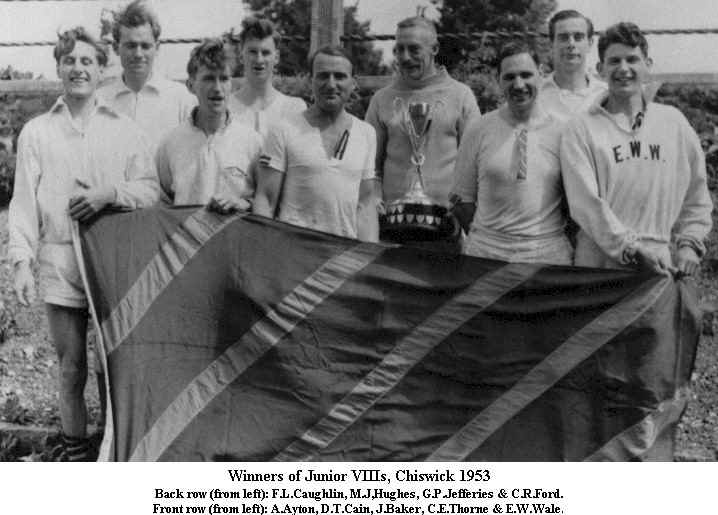
The Club got off to a good start in 1954 winning the Ibis Christmas VIIIs (Kew Bridge to Barnes Bridge) in a field of about twenty crews and finishing 43rd in the Tideway Head. After a few setbacks, this crew went on to win the Twickenham Cup for Junior VIIIs at Richmond and Twickenham Regatta. The Twickenham Cup, a magnificent piece of silver housed in a wooden crate of some dimensions, therefore passed into Cygnet's possession for one year. During the course of the evening's celebrations at Richmond, F.E.(John) Bull, the coach of the successful crew, felt it would be prudent to remove the cup to a member's home for safekeeping overnight. Genever-Watling's ancient Riley was called into service and he, Bull and one other staggered up several flights of stairs with the crate to a flat in Fulham, blissfully unaware that the `pot' was still doing the rounds at closing time in the pub at Richmond!
The successful crew at Richmond and Twickenham subsequently went on to win Junior-Senior class on three consecutive occasions at Horseferry, Willesden (Welsh Harp) and Kingston. Thus, once again, Cygnet could point to a hard core of experienced oarsmen, reminiscent of the 1930s, who were to form the basis of the victory years of the 1950s.
Throughout the period 1955-58 Cygnet crews consistently won Junior and Junior-Senior under the watchful eye of coaches John Bull and Bill Peer and, in 1956, Cygnet won Senior-Junior at Staines. Peter Roche, one of the successful oarsmen of this period, also made Club history by recording Cygnet's first ever win in an open sculling race at Horseferry Regatta.
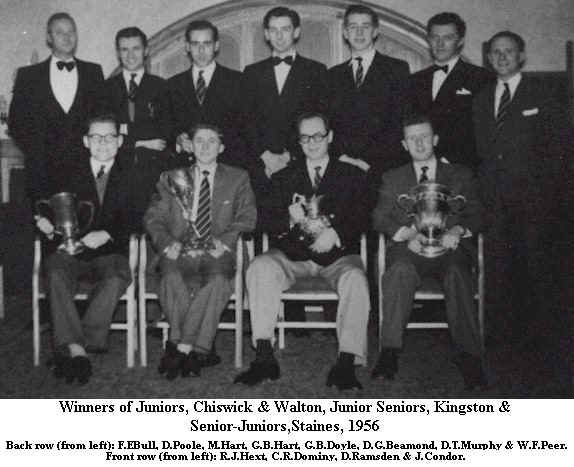
And so this decade could be said to have put Civil Service rowing back on the map. The Club had not won as many senior events as it had done in the thirties, but it had undoubtedly won more events in the Junior and Junior-Senior VIIIs class than ever before. On a broader front, this decade had witnessed the birth of the International Modern Style of rowing made popular by the Ratzeburg Club of W.Germany.
The 1960s were to be nowhere near as successful as the 1950s. Membership numbers declined and the Club passed through some very lean years. Nevertheless, this period was not without its high spots. Thus, in 1961, a Junior VIII, coxed by the indomitable Colin Dominy, won at Metropolitan and, in 1962, Cygnet triumphed over 16 other crews to regain the Twickenham Cup for the third time since the war. It was not unusual for regattas to be so hotly contested; in 1963 Novice IVs attracted 33 entries at Evesham and 27 at Worcester.
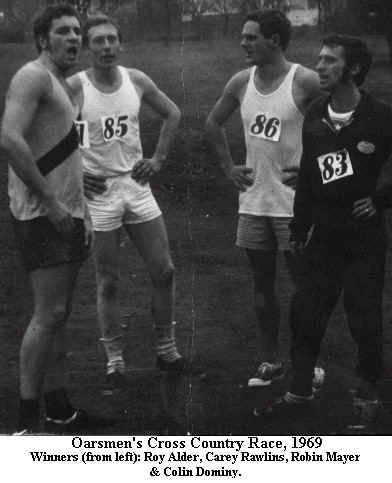
Back on land, the bungalow at Shepperton was completely rebuilt by club members in 1964 and, in 1968, Cygnet's now long-standing relationship with Benrath in West Germany began. Also in 1968, Cygnet accepted an invitation from the Civil Service Ladies to row in a mixed scratch VIIIs event and another regular Club fixture was born. Last, but not least, in 1969 a Cygnet team won the Oarsmen's Cross Country running race. Eleven years previously this race had been won outright by Malcolm Mills.
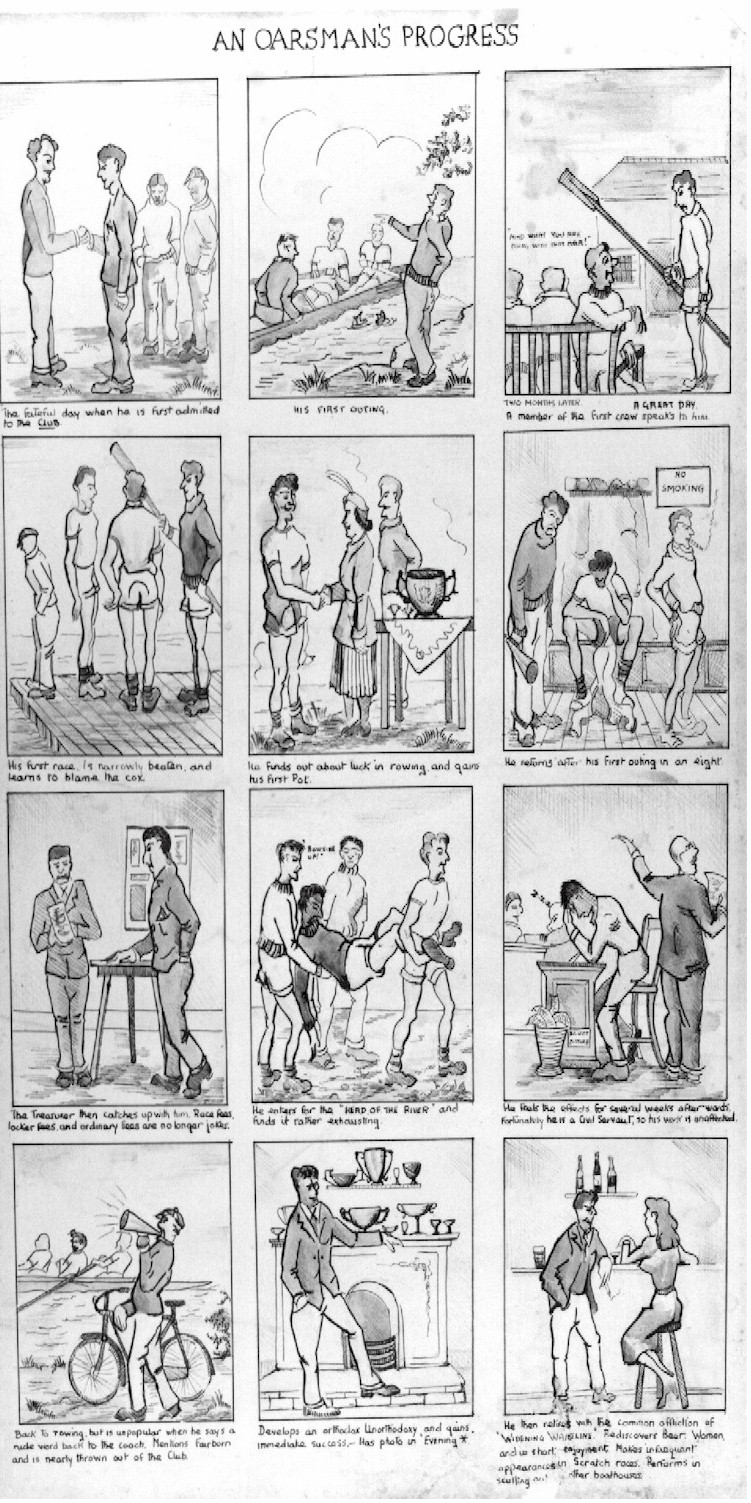
Below: The Oarsman's Progress by Ralph Prior, c.1960