| Cygnet Rowing Club |
| Illustrated History |
A Century Complete
It would be unfair to characterise any one period in the Club's history as being the most successful; after all, the thirties and the fifties would both have qualified for this accolade in their time. Nevertheless, the 1980s have been remarkable for the number of wins that the Club has enjoyed in open competition, at all levels from Novice to Elite. It is a measure of the challenge now facing Cygnet that this success has not been sustained throughout the whole decade, but it has changed the way in which the Club trains on and off the water. In particular, the emphasis on rowing in VIIIs has given way to racing in `small boats', reflecting the received wisdom of the day as much as anything. This is not to say that racing in VIIIs has been abandoned, for it has not, but the Club has been much more competitive in small boat combinations, winning at Elite for the first time in 1984. Sculling has come into its own, while the thread of veteran rowing has been maintained, not least by that hardy perennial Nicholas Wylie.
Fifteen in one
The ninety-fifth season (1984) deserves special mention, since it served as a springboard for much of the success that was to follow. It started in a climate of high expectations based on a hard core of experienced oarsmen and a large intake of newer members, most of whom had won their novices the previous year. Winter training on land consumed four nights a week, while on the water high mileage in small boats was the order of the day. Intensive coaching was administered by Messrs Beckett, du Parcq, Finlayson and Mc Veigh under the overall direction of Noel Davison, who assumed the role of squad co-ordinator (coercer to some). This strategy worked well and Club crews arrived at the start of the regatta season not only technically better, but stronger and fitter than for some years past.
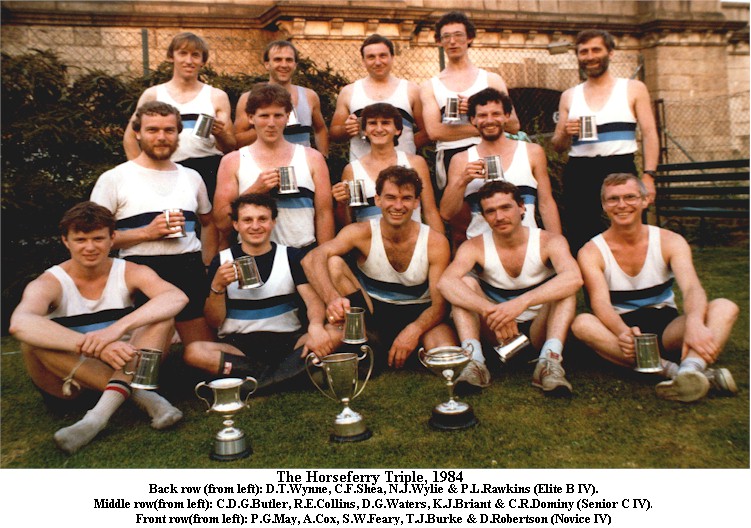
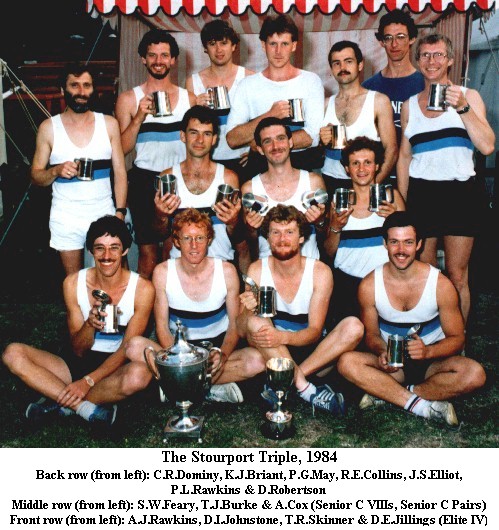
Crews generally acquitted themselves well in the head season and a Senior B coxless IV came 11th in the Henley IVs Head. This IV subsequently went on to win Senior B at Putney, Senior A at Metropolitan, Kingston and Henley Town and Elite at Stourport. It also represented the Club for the first time in the National Championships at Holme Pierrepont, Nottingham. Elsewhere, the Club enjoyed its first `triple' victory at a single regatta, when it won Novice IVs, Senior C IVs and Elite B IVs at Horseferry. A similar performance at Stourport rounded the season off well, bringing the number of wins in open competition to an unprecedented total of fifteen.
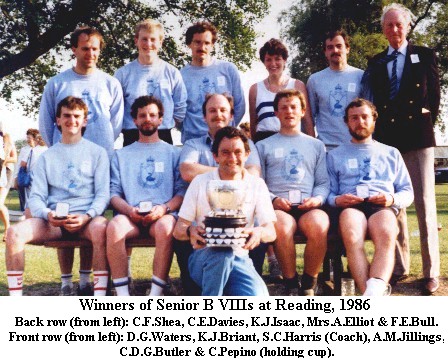
This wave of success was to continue for the next three years, so that between 1984-87 the Club could point to forty wins at all levels and in virtually every combination save double and quadruple sculls. For the record, the Club continued to maintain a presence in VIIIs, winning the Business Houses Head (1985) and Senior B VIIIs at Oxford and Gloucester (1985) and Reading (1986).
Register to race
Turning to the sport at large, the late 1980s have witnessed yet more changes in the way in which rowing is organised and financed. For example, the rules of racing have been altered to a points system that better reflects the combined experience of a crew rather than before, when the crew assumed the status of its single most experienced member. For the very status conscious, the old Senior-Junior, Junior-Senior and Junior, having become Senior A, B and C, have gone through yet another transformation to become even less inspiringly Senior 1, 2 and 3. Also, in an altogether new departure, all oarsmen intending to race in open competition now have to register individually with the ARA every year. Nor does the oarsman lack for opportunities to race; head races occur every weekend throughout the winter and two-day regattas are commonplace in the summer. Cygnet has taken these changes in its stride; club members continue to officiate at many local heads and regattas in a variety of capacities, as well as further afield like the National Championships, while the affairs of the ARA remain of more than academic interest.
One hundred at last
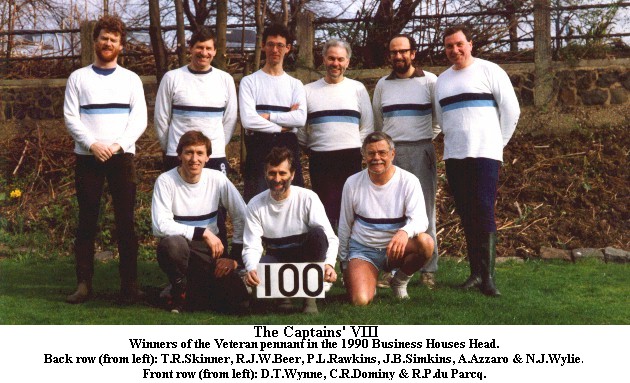
The Club's 100th season was not one of the most outstanding, but nor was it one of the worst. Sculling featured prominently in the year's catalogue of regatta wins and a triple victory was recorded at Horseferry. As this history goes to press, Centenary celebrations are in full swing. The Club's 100th anniversary was marked by a party at the Boathouse on 12th February and there will be an official reception at the Palace of Westminster in the spring. Richard du Parcq's foresight in forming an VIII of captains past and present to compete in the 1990 Business Houses Head has proved to be a fitting beginning to the 101st season. One hundred years of collective experience prevailed on the day and the Veteran pennant was won in a style best described as Fairbairnism with a dash of Ratzeburg.
Many of the personalities mentioned in the last two decades of this history continue to play an active role in the Club, while some of the more senior members like F.E.(John) Bull are still very much in evidence. Above all, the desire and enthusiasm to cultivate the art of rowing has not wavered, while Cygnet members remain as willing as ever to foster the social side.
In conclusion, to quote one senior club officer, `the Club is as happy as any of us have ever seen it, on an even financial keel and habituated to racing success. There should be good times still to come'.