OBITUARIES
We very much welcome comments from friends. Please click on the 'Comments' link at the bottom to see comments or add your own.
Note: There is a anti-spam check and comments are moderated before approval.
John Simkins
30th March 2026
John Simkins, 1948 – 2026
John Simkins, who has died at the age of 78, joined Cygnet in early 1974. If truth were told, he always regarded rowing as something of an elitist sport, yet as a British Telecom (tunnelling) engineer he perfectly matched the original criteria for Cygnet membership – an employee of the Post Office.
In contrast to the late 60s and early 70s, when graduate civil servants featured prominently among new intakes, Simkins (as he was invariably known) and his cohort were painters and decorators, electricians, plumbers and engineers. While tunnelling was not in high demand, John wasted no time in applying his skills to overhauling the boat trailer, painting the changing room and refurbishing the showers, ably assisted by his contemporaries, among them Noel Durkin, Peter Grebot, Jack Phillips, Nick Wylie and Dave Wynne.
Perhaps somewhat to John’s surprise, he rapidly developed an affinity for rowing. An early triumph was the Len Freeman Cup Novice lVs event in April 1975 which had attracted twelve entries. In the event, John stroked his crew (Messrs Wylie, Wynne and Phillips) to a four-length win, a performance that would be matched in other club events like the Balfour Fours. These were halcyon days: Phil Beckett and Wylie recall carefree outings on summer evenings coached by Alan Azzaro, followed by lengthy debriefings in the club bar afterwards. Beer and, for a short experimental period, wine flowed late into the night.
Winter training presented its own challenges, inviting suggestions of certain lifestyle changes such as moderating one’s alcoholic intake and giving up smoking. For a committed pipe smoker like Simkins, this was out of the question and he never acquiesced, notwithstanding missives from on high. Thus, minutes of a committee meeting in February 1976 noted that the captain suggested, to general agreement, that smoking in the showers and the changing room was undesirable. A notice making the committee’s view clear was duly posted (and firmly observed in the breach).
Despite this breach of etiquette, by now it was becoming clear that Simkins was seen as a safe pair of hands, always a bad sign in a bureaucracy-bound club like Cygnet, and by 1976 he had been sucked into the committee. Little did he know that he would be on fast track to higher office. Late 1976 found the club with a pool of 20+ senior C oarsmen, an iconic coach (George Plumtree) and a contested captaincy election. In the event, Richard du Parcq defeated John Bull to become captain, John stepped in as deputy and Nick Wylie as vice. And so, the stage was set for the Plumtree Years.
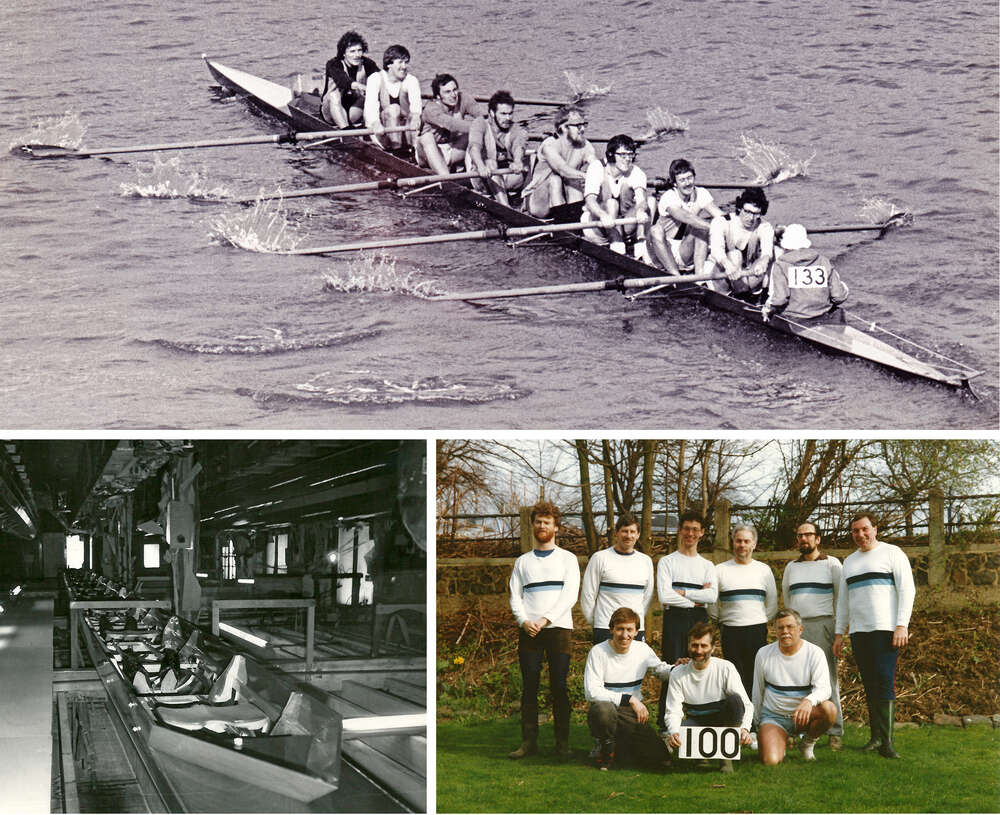
Throughout 1977–78, John rowed in the powerhouse of the Plumtree VIII (Pictured below at four in the senior C pennant winning VIII of 1977) while acting as George’s all-important point man, taking the pulse of the crew and conducting a delicate balancing act between coach and captain. Nothing less than six days training a week would do and John ensured that we all kept up to the mark, although he loathed doing sprint runs (in wellington boots) to the band stand and back before outings.
Nevertheless, the training paid off, and a bunch of rookie senior Cs ascended through the ranks to senior A by the close of 1978, having made two appearances in Thames Cup at Henley Royal along the way. John more than played his part, rebuilding the Joe Lee, an anachronism of a boat (pictured below), convincing a wavering crew to enter Henley in 1977 and pushing hard for a new boat – a state-of-the-art Carbocraft no less – in 1978.
When Alan Azzaro stepped down as captain in late 1978, John was the obvious choice for the job; he was joined by Richard Kemball-Cook (deputy) and Phil Beckett (vice). The victory years of 1977–78 were a hard act to follow and 1979 proved to be an uneventful year on the water, yet John kept the show on the road with the same steadying hand he always displayed.
By the mid-1980s, a romantic interest (Gill) found him transferring his allegiance to Auriol Kensington Rowing Club where he swiftly ended up with the task of secretary of Hammersmith Regatta. One of his last appearances on the water at Cygnet was in the 1990 Business Houses Head (pictured below, John third from right, back row) when the club marked its centenary with a captains’ VIII.
Sadly, ill health led to Gill’s untimely demise. John took redundancy from BT, started a boat chandlery business in St Neots and qualified as a gas engineer to ‘MOT’ pleasure boats. Somewhere along the way, he met Christine; they married in 2000 and emigrated to Portugal where he ended his days. Christine predeceased him. We are grateful to John’s niece, Lorraine, for informing us of his passing. John’s funeral was held in Portugal on 19 February. There will be a private customary sprinkling of his ashes on the Thames at some point, followed by a memorial gathering later in the year.
As fellow Cygnet member Rod Beer commented on being informed of John’s demise, he was an unassuming soul who loved his rowing and the Club. Whatever else, he surely hid his light under a bushel.
Paul Rawkins, 27 March 2026
Colin Dominy
23rd January 2026
Colin Dominy, 1936 – 2026
Earlier this month, Lynne Dominy wrote to the club to inform us that her uncle, Colin Dominy, had passed away on 3rd January. He was just weeks short of his 90th birthday.
Colin joined Cygnet in 1954 at the tender age of 17 having just come to London to take up employment as a civil servant with the Air Ministry. On his application form, which we still have, in answer to the question ‘Previous Rowing Club’ he proudly wrote NONE. Yet he took to the Thames like a fish to water and would become one of the most experienced and sought after coxswains on the Tideway.
Colin counted the likes of Mike Arnold-Gillat, Barney Frith, Derek Bush, John Ellis, Len Hoskins, Len Huggett and Peter Roche among his contemporaries. They were the club stalwarts of their day who would pass the Cygnet ethos on to new members. One way or another, they would all leave their mark on the club and Colin was no exception. Indeed, flicking through the index of C H Genever Watling’s write up of the club history from 1950-76, no member receives more mentions than Colin Dominy.
Two members – Norman Cowling and Lawrence McVeigh – were kind enough to share their extensive memories of Colin with me. Both recall an individual who may have been short of stature but was utterly dedicated in everything he did whether it be coxing, rowing or cross-country running. Norman opined that he was literally a light weight, but in every other way a heavy weight with a determination to win. Lawrence concurred: he was an excellent cox and could be fairly aggressive in a race, particularly if he felt he could get one over on an opposing crew.
Colin first rose to prominence in the second half of the 1950s when Cygnet was enjoying something of a resurgence following a lean patch during the early post war years. Thus, in 1956, a ‘junior’/’junior-senior’ Vlll won a string of victories with Colin at the helm. Further victories would follow, many captured in the club’s photo archives with Colin invariably sat centre stage. By the end of the fifties, Cygnet could look back on its most successful period since the thirties: the club had undoubtedly won more events in the junior and junior senior Vllls class than ever before and Colin had had a hand in most of them, variously coxing and coaching.
The 1960s were nowhere near as successful as the previous decade. With competitive Cygnet crews few and far between, in 1965 Colin accepted an invitation to cox Nautilus, the forerunner of the National Squad, coached by George Plumtree, rowing out of Twickenham RC. Lawrence recollects: Colin’s first contribution was coxing a brand-new Stampfli lV+ doing a piece in the cut inside Eel Pie Island when a boat appeared unexpectedly and took the bows off completely. He was embarrassed but they didn’t throw him out. Nautilus had its moments, winning The Golden Oar in Antwerp among other international events, but it never fully lived up to expectations and by the late 1960s Colin was back in the Cygnet fold, becoming club captain in 1968-69.
Rowing was never the be-all and end-all for Colin; he was also a very fast runner. In an era when running was a central feature of winter training, he regularly led the pack on Tuesday and Thursday evening laps round the bridges or through Richmond Park. An indispensable team participant in the Oarsmen’s Cross Country organized by Black Heath Harriers, he usually led the Cygnet contingent home, not least in 1969 when Cygnet won the event outright.
No obituary of Colin would be complete without mention of his wife Isobel pictured here at a Cygnet dinner dance in the 1960s. Lawrence claims a small part in this union: I invited Isobel and some other young women I knew through work down to a Cygnet party and the Civil Service Boathouse worked its usual magic. ‘Issy’ took up rowing at St George’s, who also rowed out of the CSBH at this time, and they were married in 1967. As Norman notes, together they were a formidable rowing couple in the boathouse.
By the time I joined Cygnet in the early 1970s, being piloted by Colin was a rite of passage for any self-respecting crew and they all trusted him implicitly. Yet, like every cox, Colin yearned to row. And so it was, in 1974-75, that Colin joined myself, my brother Andy and Steve Reeves in a novice lV that would win the non-status John Cork Cup before securing the ‘real thing’ at Barnes & Mortlake regatta. Norman recalls: I remember the pleasure everyone took when he won novice fours. The trophy was huge and we refilled it many times.
Being a lightweight could have its drawbacks. Thus, on one occasion, while rowing bow in an Vlll he caught a humongous crab which lifted him out of his seat and catapulted him the length of the Vlll. As he sailed over our heads, the rest of us reflected that there must be easier ways to conduct seat trials. Yet, true to form, Colin took it all in his stride and simply added the episode to his rich tapestry of a life afloat.
Colin would remain in evidence at Cygnet until the 1980s when the Civil Service Boathouse Executive asked St George’s to look for new premises. They settled on Twickenham RC and Colin and ‘Issy’ duly relocated with them before upping sticks again to Caversham where he joined Reading RC for a time. In later years, he took up golf, playing regularly with local friends.
Colin and ‘Issy’ were both early supporters of Henley Women’s Regatta and contributed financially to its success. He also attended the Cygnet Veteran’s Lunch at Leander, happily conversing with ‘old hands’ over a beer or two, but never staying to dine. After ‘Issy’ died he moved into sheltered accommodation in Reading for a time, while continuing to play golf. His twilight years were spent in Tisbury in Wiltshire, his birthplace, where he moved to be nearer to his family.
Coxswains come and go, but few display the longevity, commitment and sheer skill that Colin Dominy did. He was one of a kind and Cygnet was lucky to have him. His funeral will be held on Thursday 29th January at 2pm at Salisbury Crematorium, Barrington Road, Salisbury SP1 3JB.
Paul Rawkins, 23rd January 2026 (with thanks to Lawrence McVeigh and Norman Cowling)

John Ellis
26th September 2025
John Ellis, 1933 – 2025
Not everybody craves the limelight; some like John Ellis, who died on the evening of 8th September aged 92, are destined to play a support role, and so it was that John often appeared alongside his wife Dame Diana Ellis, chair of British Rowing, at countless official events throughout her long term of office.
Although Cygnet was the main civil service rowing club post war, there were others, among them Crescent, another post office club based on the River Lee. Throughout the 1950s and 60s Crescent would often field crews for the annual civil service regatta, frequently walking away with the silver. For some Crescent members like John Ellis and Len Huggett, the draw of the Tideway was hard to resist and both would defect to Cygnet in the late 1950s.
John may not have been a noisy individual but, as Lawrence McVeigh remembers, he was a successful Cygnet stroke, noted for his long, graceful smooth technique. Thus, the early 1960s found John rowing in several club eights at a host of Tideway regattas and the Serpentine. In due course, John met Di, a fellow stroke, rowing for St George’s, who also boated from the civil service boathouse (and stroked the GB Women’s Vlll at the European Championships in 1966) and another successful matrimonial union was struck.
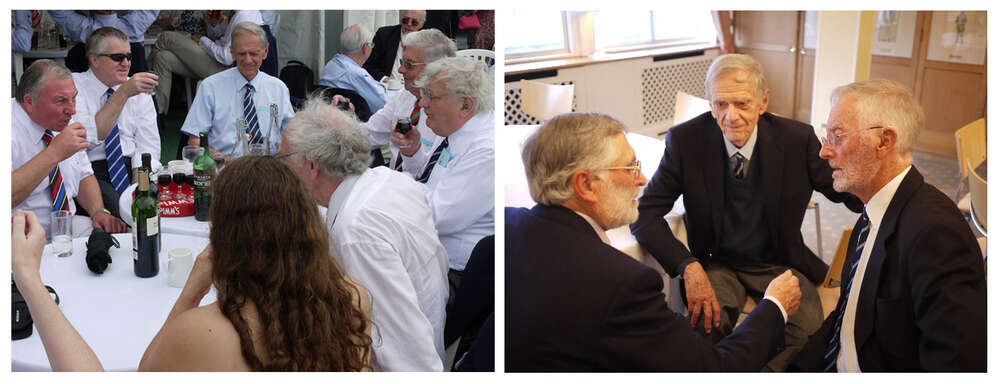
John, probably wisely, never quite succumbed to the Last of the Summer Wine set, which met at the boathouse on Tuesdays and Thursdays. However, John and Len Huggett remained lifelong pals, often meeting up during retirement, Len ever full of bonhomie and John always on hand to see him safely home. It was a tried and tested combination. On those rare occasions when John put his head above the parapet, so to speak, it was usually at the annual president’s lunch at Henley or the veterans lunch at Leander, both of which provided the few picture opportunities that we have of John.
Di passed away in 2017 and John spent his last few years in a care home in Sussex. He is survived by a daughter, Claire and grandchildren Dan & Joe. The funeral will be held at 12.00 on 10th October at Wealden Crematorium, Horam Road, Horam, East Sussex TN21 0FX.
Paul Rawkins, 25th September 2025