
| Cygnet Rowing Club |
| Illustrated History |
Social Occasions
As Dusty Miller says in his account of the Club history from 1890 to 1950, `Cygnet had ever been a Club to foster the social side'. The first record of an annual Club social occasion appears at the end of 1890 when a supper and smoking concert was held at Anderton's Hotel. Invitations were sent to the editors of `The Sportsman', `Sporting Life', `News of the World' and the `Lock to Lock Times', all of which were accepted. Toasts on the night included `The Press and The Visitors'. Today, the press would be conspicuous by their absence, replaced by guests from neighbouring clubs.
Prize giving
The earliest programme available is for the Sixth Annual Dinner and Concert held on 1st February 1896. The concert was under the direction of Lindley Darby and consisted of various songs, several toasts and a presentation of prizes for races won over the past season. The list of prizes is particularly interesting and contrasts sharply with the pewter tankards so coveted by today's oarsmen. Thus, the bow man of the winning crew in the double sculls would have been seen to be struggling away with a writing desk, while his stroke man, on the other hand, received a teapot. Other no less startling choices included a case of carvers, a salad bowl, Gladstone bags, butter dishes, biscuit boxes and a telescope as a consolation prize for the sculling handicap.
Bohemian concerts
To return to the concerts, these came to be referred to as the Annual Bohemian Concerts and they remained a very popular feature in the Club's social calendar up until the 1920s. They were held at such venues as the Haunch of Venison and the Baronial Hall in the City; a great deal of care went into their organisation and tickets were frequently sold out far in advance.
The printed programmes for these occasions were often very elaborate. A particularly fine example was the Souvenir Programme for the twenty-first Annual Concert held in 1911, which contained sixteen pages, including the photogravure which appears on page four of this book. Typically, these evenings would take the form of musical fare like Elgar's Pomp and Circumstance marches, interspersed with humorous songs and sketches such as Alexander's Ragtime Band.
Musical leanings
Given the Club's musical leanings in those early years, it was only natural that it should propagate an orchestra. This first appeared as a quintet in 1912, consisting of two violins, a cello, a piano and a flute played by J.F.W.Harris. The addition of a clarinet in 1913 ushered in the Cygnet Sextet and in 1914 it blossomed into a full blown orchestra. The Cygnet Orchestra played overtures, selections and medleys and was much in demand for concerts, launch trips and other functions. Sadly, the First World War marked its demise and there is no mention of its resurrection thereafter.
The Club's musical leanings were to be rekindled again in 1931 when H.C.Fitzpatrick, who joined the Club in 1928, wrote the `Cygnet Rowing Song', which was often sung at Club gatherings in the 1930s. Some of the verses seem dated now, but the chorus at least warrants some mention here.

The dinner and dance
During the 1930s, the Annual Dinner and Concert gave way to the Annual Dinner and Dance and Social, and eventually simply the Annual Dinner and Dance. Dancing had become part of the proceedings fairly early on and reflected the changing social habits of the time. Indeed, it was not unusual for the Club to hold at least two dances a year in central London in the thirties. A popular venue for these was the Finsbury Town Hall.
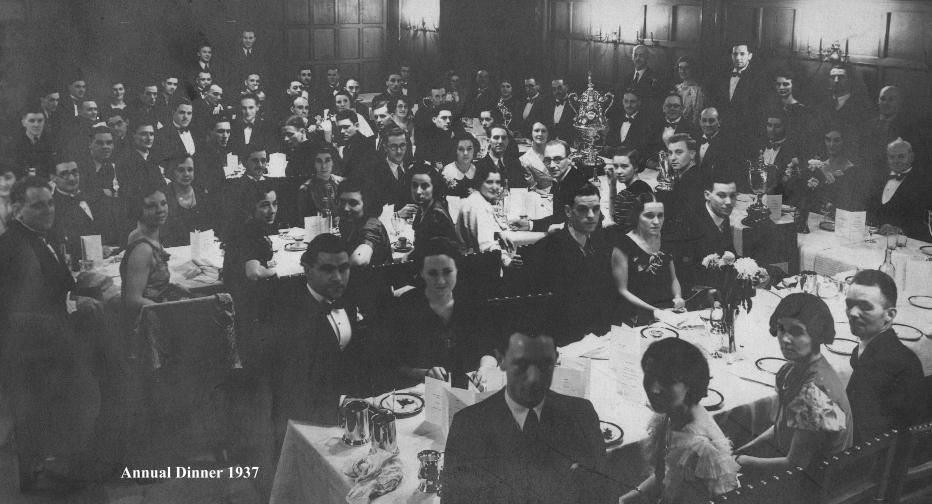
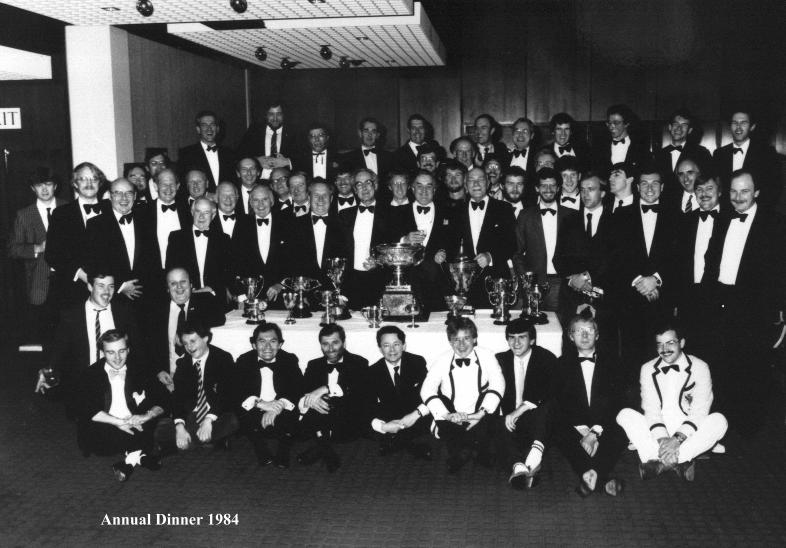
Following the Second World War, the Club began to hold its dinners and dances at the Civil Service Pavilion at Chiswick. However, in 1950 Cygnet re-established one of its links with the 1930s and changed the venue to the Bull at Sheen to mark the Club's Diamond Jubilee. The popularity of the Annual Dinner and Dance appears to have waned thereafter and by 1965 the Club had ceased to hold this occasion. This sad state of affairs was rectified in 1969 when the new Civil Service Pavilion was opened, complete with a larger dining room. This, plus the fact that the Club managed to engage `a rather good four piece band', seems to have put the event back on the road to recovery.
During the last twenty years the popularity of the Annual Dinner and Dance has waxed and waned with the fortunes of the Club. By the end of the 1970s the Club had outgrown the Civil Service Pavilion and began to look around for an alternative venue. These have been many ranging from the now demolished Bull at Sheen, to the Dog and Fox at Wimbledon and the Star and Garter Hotel at Richmond. In recent years the Club has found the Rose Room (and latterly, the West Pavilion suite) at Twickenham to be best suited to its requirements. Cygnet has been fortunate to entertain some very distinguished speakers in recent years including Peter Coni QC, Chairman of Henley Royal Regatta, and Colin Moynihan MP, the present Minister for Sport. The Rose Room will be the venue for the President's Ball to mark the Centenary in 1990.