| Cygnet Rowing Club |
| Illustrated History |
The Thirties
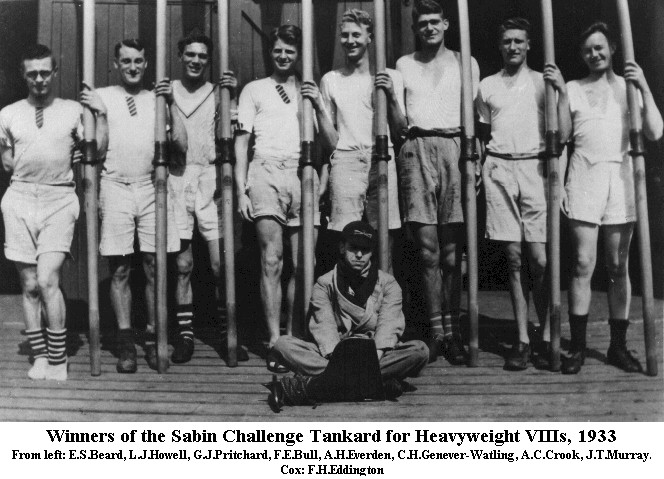
The early 1930s were the precursor of modern day squad rowing as we know it at Cygnet and laid the foundation for what were to be some of the Club's most successful years. By the mid-1930s the Club had acquired a hard core of experienced oarsmen like F.E.Bull, E.E.Fray, C.H.Genever-Watling, G.P.Jefferies, E.T.J.Lee, G.W.Mealing and others. These men had benefited from the foresight of Jack Sheppard and Dan Gallagher, who were quick to appreciate their racing potential and arranged for them to be coached by the likes of Southwood (Thames), Harry (Quintin) and, of course, Lew Barry. Under their tutelage, Cygnet came 32nd in the Tideway Head in 1933 and went on to win both the Sabin Lightweight and Heavyweight Vllls events in the same year.
The victory years
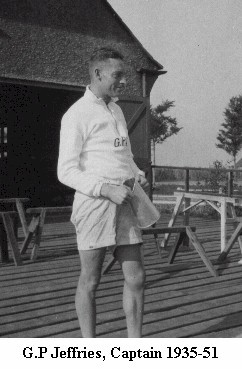
G.P.Jefferies assumed the Captaincy in 1935 and the Club went from strength to strength so that by 1936 it was clear that Cygnet had the potential to go it alone, rather than row under the flag of the Civil Service Rowing Association (CSRA). Up until this time, many of the Club's best oarsmen had been selected each year to row in representative CSRA crews and were therefore lost to Cygnet for most of the season. However, in 1936 winter training commenced for a purely Cygnet VIII and a heavy racing programme was planned for 1937, much along the lines of today. A `Regatta Fund' was instituted and Cygnet duly competed at Hammersmith, Putney, Chiswick, Kingston and Kingston Borough regattas; it also represented the Civil Service at the Metropolitan, Molesey and Staines. Victory came swiftly with a win in Junior VIIIs at Putney (F.E.Bull rowing stroke), followed by Junior-Senior VIIIs at Metropolitan and Staines. The 1937 season thus served to put Civil Service rowing on the map in terms of open competition.
Sculling Championship of England
In a lighter vein, on the Easter Monday of 1937 a Cygnet VIII acted as the pilot boat in the Sculling Championship of England between Eric Phelps and Lew Barry. It must have been an unusual sight, to say the least; the VIII rowed as VII, the bow seat being occupied by Bert Barry. Bert sat facing the bow so that he could steer his brother over the course from Putney to Mortlake, thus saving him the trouble of looking round to determine his course. The race was an exciting one with both men sculling level for three quarters of the course. The Cygnet oarsmen acquitted themselves well by all accounts, but Lew Barry ultimately lost by four lengths.
Building on the success of 1937, Cygnet started 1938 with a much higher goal in its sights; that goal was to win at Thames Cup level and to compete at Henley Royal Regatta. Confusing though this may sound, they were really two quite separate goals. The Thames Cup event was the premier event of the day at most regattas. The season started well with Cygnet finishing 10th in the Tideway Head, putting it among the fastest Club crews of the day. Attention then turned to the Thames Cup events at upriver regattas. Cygnet attained its goal at its first regatta when it beat the Metropolitan Police in Thames Cup at Walton, thereby making Club history. A win at Chiswick the following week meant that Cygnet had won the first two Thames Cup events of the 1938 season. After Chiswick, this crew donned the colours of the Civil Service Rowing Association to compete at Henley Royal Regatta for the first time, a milestone which receives greater coverage later in this book.

Cygnet were to win Thames Cup once more before the Second World War at Molesey in 1939. And so the inter-war period could be said to have ended on a high note. On the whole, it had been the Club's most successful period since it began.