| Cygnet Rowing Club |
| Illustrated History |
The Boathouse
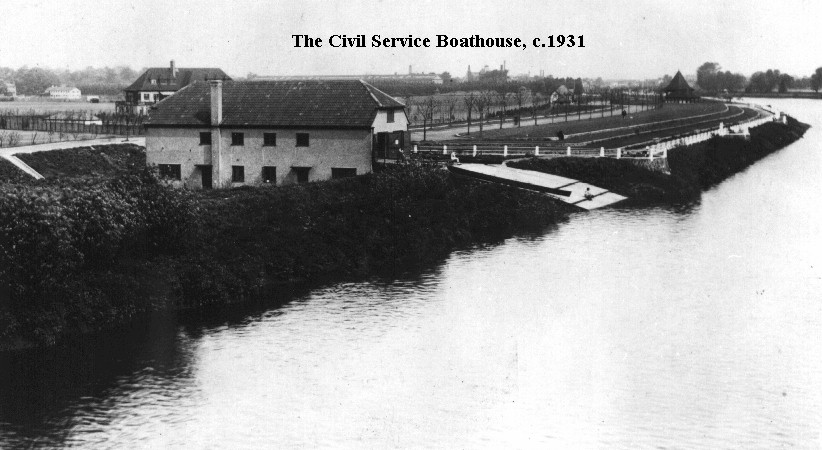
Cygnet's Centenary coincides with the Diamond Jubilee of the Civil Service Boathouse. Work began on the boathouse in March 1930 and was completed in October of the same year. At this time, no provision was made for a bar or a clubroom, accommodation being restricted simply to the boatshop and the changing rooms. Initially all the boats were owned by the Civil Service Rowing Association and consisted of heavy clinker pairs, IVs and VIIIs, some of which still survive today.
Bob Dowson
This history would be incomplete if it did not mention Bob Dowson, the boatman, who was employed by the Civil Service in 1930 and was to serve in that capacity until his retirement in 1976. Bob had served his apprenticeship at neighbouring Tom Green's Boathouse and was one of the last professional boatmen to grace the Thames. For those of us who knew him, Bob's bark was much worse than his bite and never more so than on a Sunday morning, if the strokeman (or woman) had omitted to collect sixpence (and later 1/-) from each of his fellow crew members for the Boatman's beer money.
To begin with, Cygnet was only one of a number of clubs boating from the Chiswick boathouse; others included the Post Office Savings Bank, the Ministry of Health and Customs & Excise. Women's clubs were equally numerous, although contact between the two sides of the Boathouse does not seem to have been as close as it is today. Nevertheless, a great spirit of rivalry existed between the clubs on each side and this manifested itself in the Civil Service Regattas, which were always well attended.
With the outbreak of war in 1939, the Boathouse was requisitioned as a mortuary, although it was never used as such. During the war, it sustained slight bomb damage on account of the close proximity of the railway. Also during these years, arrangements were made for clubs to boat out of Tom Green's, Mortlake and National Provincial Bank's boathouses. The Civil Service Boathouse reopened in July 1946 and Cygnet immediately set about partitioning the dressing room to make way for a bar-cum-clubroom. The bar was officially opened on 12th October, 1946 and a picture of those early drinking days is shown here.

The great flood
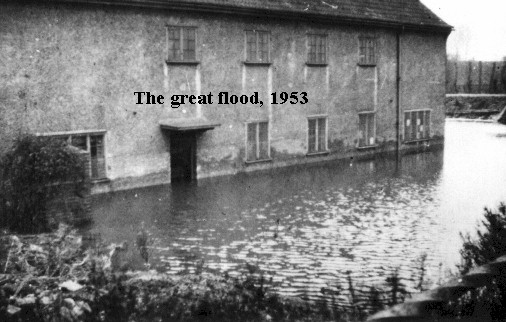
The concrete flood prevention walls that surround the Boathouse today are a relatively new addition (1976) to the landscape, although they predate the Thames Barrier at Woolwich. In 1953, no such safeguards existed and a wall of water surged up the Tideway, breaching the wall at Chiswick and flooding the Boathouse to a depth of five feet. At this time, the Emanuel School Boathouse had not been built and the Civil Service was thus isolated in a small lake. There being no way for the water to escape, the London Fire Brigade was called in to pump it away. Needless to say, the lawn, which had been only newly created from turfs salvaged from the Civil Service Sports Ground grass tennis courts, was covered in several inches of Thames mud and had to be scraped away by willing members.
Emanuel School Boathouse was built immediately next door to the Civil Service in 1960, notwithstanding the threat to the `Biblicarta', a rare species of snail which occupied this ground and had prevented its development up until this date. Soon afterwards, Emanuel extended the boating hard and built a rowing tank, both of which greatly improved the facilities available at Chiswick. Cygnet was also able to observe at first hand the ascent of school rowing and John Cork, the boatman at Emanuel, was to become a firm friend of the Club.
Civil service ladies
No history of Cygnet Rowing Club could ignore the Civil Service Ladies Rowing Club (CSLRC) which, like Cygnet, has absorbed other service clubs to become the main representative of women's rowing in the Civil Service. Living under one roof has meant that relations between the two clubs have sometimes become heated over Boathouse matters, but generally convivial in most other respects.
Close bonds have been formed over the years, leading to matrimony for some like the Alders, Beers, du Parcqs, Elkins, Hutchins, Murphys, Pratts, Rudlins, Slys and Wynnes, to name but a few. On one occasion, in 1981, the two clubs were fortunate to have a husband and wife combination, when Rodney Beer became captain of Cygnet and Gillian captain of the Ladies. Close inter-club ties have also bred many social occasions ranging from winter teas on Saturday afternoons to `Come as You Are' parties, `Roman Orgies', the Annual Croquet Match, and, latterly, a Grand Summer Ball.
Merit awards
Even the most cursory glance through these pages will reveal that there are those who have been closely involved with the Club for many years. This is also true of the CSLRC. Hence, it should come as no surprise to learn that individuals from both clubs have been nominated to receive the Civil Service Merit Award for long service to sport and recreation. John Bull was the first member of Cygnet to gain this award in 1979. He has since been joined by `Genny' Watling and Mike Arnold-Gilliat on the men's side, and Irene Sanders on the ladies' side.

And what of the Boathouse itself? It too has done sterling service. The fabric of the building remains much as it was sixty years ago, although the bar has passed through several reincarnations, the last with the assistance of Fullers Brewery, and the shower facilities have been greatly improved. Unfortunately, the Boathouse, in the guise of the Civil Service Boathouse Executive (CSBE), can no longer afford the luxury of a boatman and his work space has been taken up with extra boat racks. These days the CSBE is mainly concerned with the upkeep of the building; most boats are owned by the clubs outright, with the exception of a tub IV, a light, plastic skiff and a couple of the original clinker pairs. Perhaps the most apparent encroachment of the late twentieth century is an ergometer (or rowing machine), an instrument of torture for some, positioned immediately inside the doors of the Boathouse.
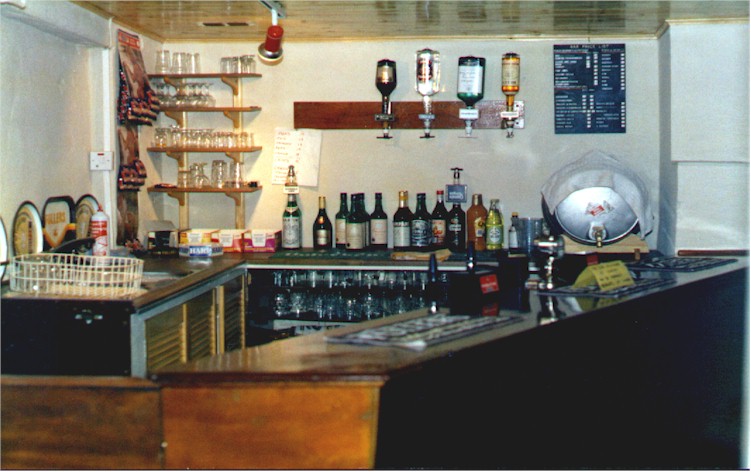
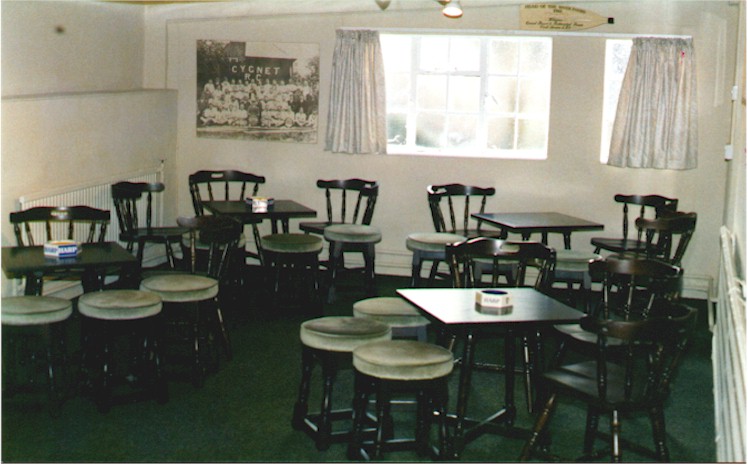
Two views of the new bar, refurbished in 1988 with the assistance of Fullers Brewery.