| Cygnet Rowing Club |
| Illustrated History |
The Boats
The concept of a club like Cygnet owning its own boats is a comparatively recent one. As this short history has already revealed, in the early years it was customary for rowing clubs to rent boats from the commercial boathouses of the time. This custom continued right up until the 1930s when the Club moved to the Civil Service Boathouse at Chiswick.
The range of hire boats available to the Club seems to have embraced the whole spectrum from sculls through to VIIIs. The new member was assured of coaching on `orthodox' lines; this entailed a fairly lengthy period of training on fixed seats, before graduation to `slides'. The advent of the `Fairbairn' style of rowing hastened the demise of fixed-seats and by the mid-1920s many of the larger clubs had abandoned fixed seat rowing altogether. Nevertheless, as late as 1926 Cygnet was still competing in (and winning) Tideway Fixed Seat VIIIs for `Maiden' (Novice) crews.
Pins and rowlocks
The move to Chiswick gave Cygnet access to boats with swivel rowlocks, as opposed to fixed thole pins, for the first time. While these were not new, Cygnet was fortunate to be exposed fairly early on to yet another Fairbairn-inspired development, which was rapidly gaining in popularity. The Civil Service Boathouse was equipped with clinker IVs and very heavy clinker VIIIs built to withstand constant use (or perhaps misuse). Maintenance and repair of these boats fell to Bob Dowson, the boatman employed by the Civil Service.
Go-faster clinker and shell
It was not long before Cygnet approached the Civil Service Boathouse for a new, lightweight `shaved' clinker VIII. This was duly purchased from Sims of Putney for £125.17.0, including a set of blades and amply justified the expense during the following regatta season. Soon afterwards, in 1935, the Boathouse purchased its first shell VIII, which stood the Club in equally good stead during the successful years of 1937-9.
After the Second World War Cygnet acquired its first coxless IV in 1949, which was christened the Lewis Balfour. This boat had originally been built for a crew to row in the Olympic Games. The fashion to name boats after individuals continued with the christening of the G.P.Jefferies, in 1958, which was one of the last VIIIs of cedar construction to be built on the Tideway. The photographs on the following pages chronicle some of the many boat christenings which have taken place since then and serve to illustrate how much the whole art of boat building has changed over the last thirty years. Another mark of the changing times has been the abandonment of the bicycle for the coaching launch. Minutes of a committee meeting in 1959 document how it had finally become necessary to purchase a second-hand launch for £140, due to the deplorable state of the towpath.
Plastic and all that
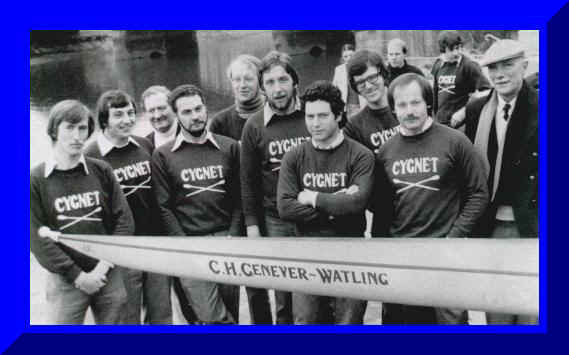
The improvement in rowing racing boats since the 1960s has been enormous. Sectionalised VIIIs began to appear in the mid-1960s, closely followed by Macon-shaped oars. Cygnet purchased its last wooden VIII in 1972, since when boats of wooden construction have steadily given way to such materials as carbon fibre, plastic and kevlar. The Club has not been slow to move with the times. Thus, in 1978 Cygnet bought one of the very first carbon fibre (Carbocraft) VIIIs, which was christened the C.H.Genever-Watling; other VIIIs, IVs and pairs have followed from Aylings and rival boatbuilders Janousek. Technology has also made the coxswains task a little easier; electronic sound systems now enable him to make himself heard throughout the length of an VIII, while more sophisticated versions of the 'coxbox' will do just about anything except steer the boat.
The advance of technology has gone hand in hand with inflation, so that the price of an VIII and a set of blades is now close to £9,000. At the same time, Civil Service Sports Council grants and interest free loans have gradually been phased out and the Club now relies exclusively on its own resources to buy boats. The Cygnet 300 Club, a lottery of sorts, has proved invaluable in this regard. Similarly, the adoption of a 10-year rolling plan for the purchase of boats and blades has meant that Club members now have access to a better range of equipment than ever before.
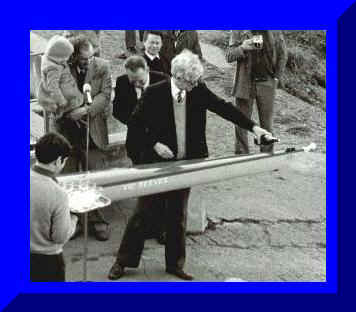
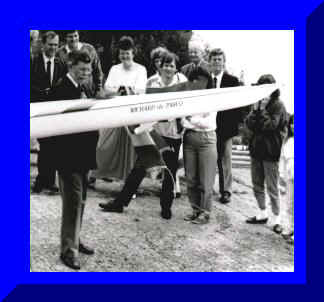
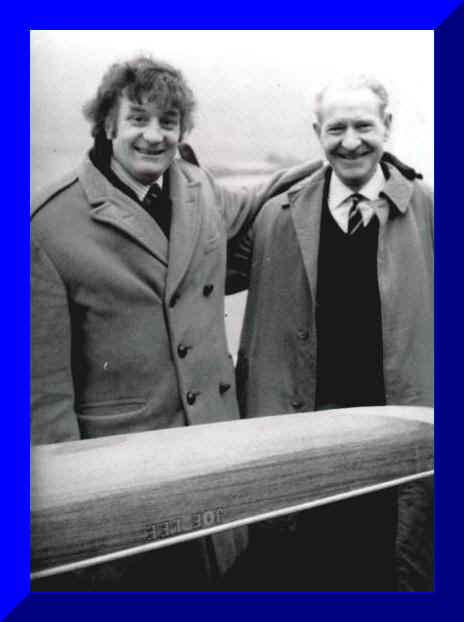
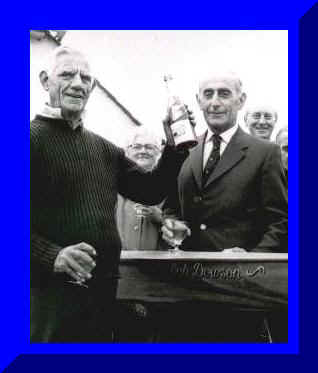
The Rogues Gallery...two decades of boat launchings
Joe Lee, 1972.
Sir Richard Hayward,
1973.
Bob
Dowson, 1975. C.H.Genever-Watling,1978.
(right)
(left)
(right)
Vic Reeves, 1981.
Mike Arnold-Gilliat, 1984.
Peter
Sly, 1985. Richard du Parcq, 1987.