


Richard du Parcq
4th September 2025
Dr Richard du Parcq, 1943–2025
George Bernard Shaw memorably wrote I’m sorry this letter is so long. I didn’t have time to write a short one. Richard du Parcq, du P to his friends, who died on 25 August at the age of 82, took this famous utterance to new heights or perhaps lengths. He was completely incapable of writing a short email, still less mastering an answerphone. Zoom presented a whole new set of challenges, while firewalls, malware and the like simply defied comprehension.
Richard first encountered email in 1994; thousands of electronic missives would follow, each imprinted with his own unique turn of phrase, always running to many paragraphs, often tangential to the topic in hand. Thankfully, I rarely deleted them; they form a rich tapestry of his life, not to mention an invaluable aide memoire to writing this obituary.
About a month before he died, Richard wrote to the secretary at Cygnet informing him that he would be unable to attend the forthcoming ordinary general meeting. Typically, he went into further detail, describing himself as a well-disposed old fart, living just across the river, active 1968-1990s, who now has a mystery set of medical symptoms which has been puzzling Kingston Hospital once or twice a week in recent months. His symptoms would defy diagnosis until very late in the day, yet he had nothing but praise for the fifty-something professionals from every corner of the globe who had ministered to him, reflecting that just now, I find it hard to argue against immigration.
As it happened, the date of the OGM – 23 July – was a poignant one, coming just a week after Richard’s 56th anniversary as a member of Cygnet. His application form, dated 16 July 1969, informed the membership secretary that his full name was Richard Poole du Parcq, living in a basement on Kennington Road SE11, while gainfully employed in the Management Services Department of the Metropolitan Police, where he would remain for the whole of his working life. He listed his previous rowing club as Exeter College, Oxford.
Richard was born in 1943 in Godalming, Surrey, the eldest child of John and Ann du Parcq. Growing up in an academic household, he seems to have been a studious child who steered well clear of most sport, especially rugby while at Cheltenham College. In 1961, he went up to Oxford, where he would spend the next seven years studying his mother’s subject (chemistry) at his father’s college (Exeter), emerging with a PhD in 1968. Yet his formidable intellect betrayed an enduring love for English and History.
Life at Oxford had many compensations. It was here that he developed his passion for rowing, while making lifelong friends of Phil Beckett and Neil Jackson (also Cygnet members), among others, as well as starring in a notorious episode of University Challenge with Stanley Johnson, inviting a strong rebuke from quizmaster Bamber Gascoigne for unscholarly behaviour towards the opposing team.
Richard was never under any illusion that he would make the blue boat. In his own words: my rowing owed more to enthusiasm, and great love of the sport, than to physique or any innate ability. Nevertheless, 1962 found him rowing in the college’s second VIII; by 1963 he had graduated to the first VIII, stroked by Phil Beckett, rowing in open competition at Reading and Marlow. Longer acts of endurance followed in the Boston Marathon in 1964 and ’66. In those days, it was customary to preseason at Leander, where he recalled sharing a shower with Jack Beresford of 1936 Olympic gold medal fame. Their paths would cross again in the Tommy Steele movie ‘Half a Sixpence’, when Richard played a bankside extra at Henley and Beresford an umpire.
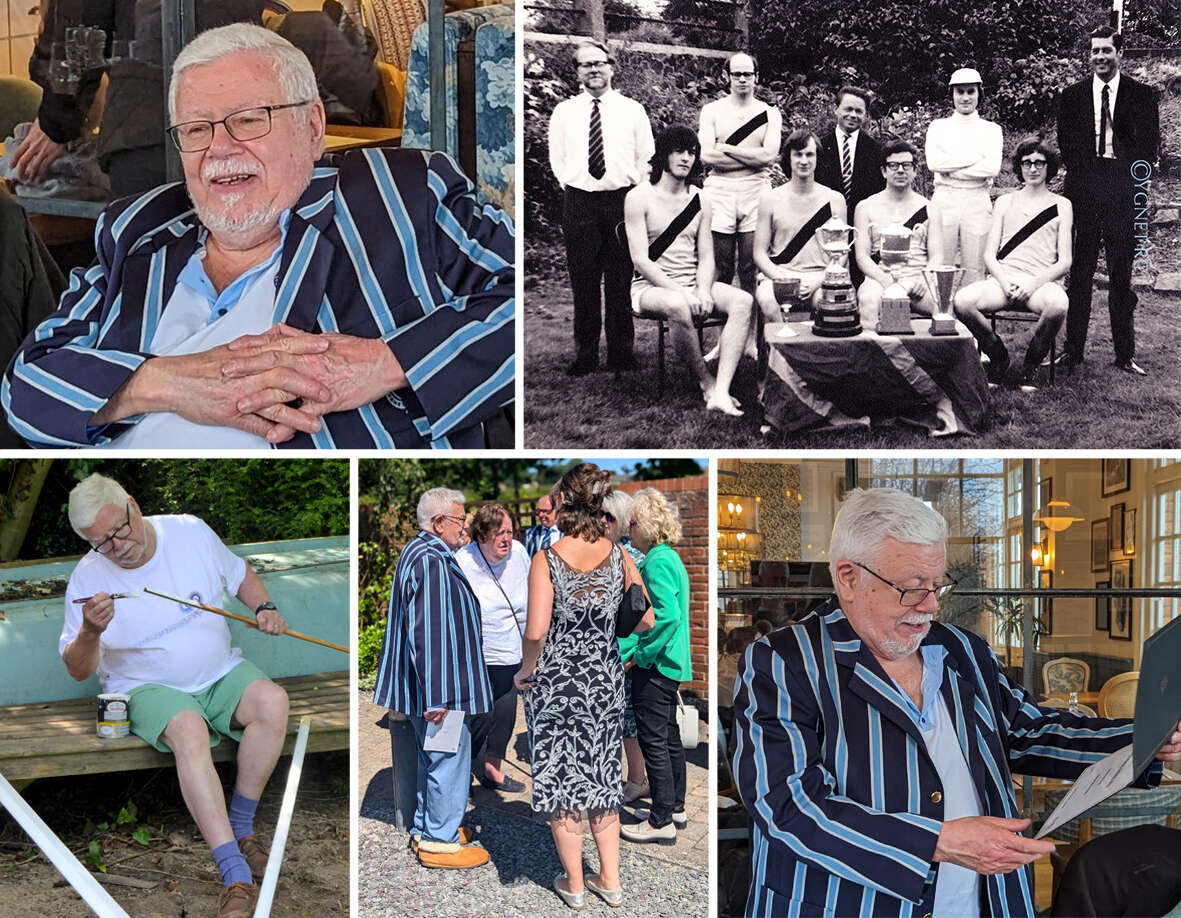
Richard joined Cygnet – the best rowing club in the world – a time when it was starting to draw away from its post office roots, attracting a new wave of graduates. Among them was Normal Cowling who recalled: he (Richard) was the spare man for the 1972 Thames Cup VIII, a difficult role that he carried out with good grace and humour. After Henley he came back into the eight and was a key man in picking up some consolation pots (to add to his coveted novice IVs win at Worcester earlier in the year). Further consolation followed with a star appearance in an advertising feature afloat for Double Diamond; said to work wonders, it was no match for Richard’s lethal homemade wines.
Older hands at Cygnet are fond of quipping that Cygnet is a marriage bureau masquerading as a rowing club. Richard rarely let his work interfere with life outside the office and he was unaware of a colleague, Diane Clark, who worked at Scotland Yard concurrently. Yet fate was already on the case: Diane rowed at Chiswick for the Civil Service Ladies Rowing Club and their paths would duly cross in the bar après rowing. They married in 1973 after a stag night that appeared to go on for days (when it was not fashionable), setting up home in Barnes and begetting five children (and six grandchildren) during 52 years of marriage.
None of the children shared their parents’ love of rowing, but they all have fond memories of terrorising the club on a Sunday morning while awaiting their parents’ return from their respective outings. Yet all appreciate the overarching role rowing played in their father’s life. Phoebe du Parcq opines: The rowing club encapsulated so much of what was important to dad – a community that welcomed everyone and built on a shared set of values.
What Richard may have lacked in physical attributes on the water, he more than made up for on land, serving as captain twice (1979, 1989–90), along with long stints as secretary, treasurer and committee member, interspersed with coaching, coxing and even gym instruction. His enduring legacy will be the Ten-Year Boat Buying Programme which he devised in 1979. This would transform the club’s fleet from what we jokingly used to refer to as firewood into one of the best stocked boat clubs on the Tideway, one of which was named after him. A Civil Service Merit Award would follow in the 2000s for long service to sport and recreation in the public sector.
He will be remembered, too, for his high-brow coxing commands such as four, I fear you are the architect of your own misfortunes, which often drew a blank from the hapless recipient, but a wry smile from the rest of the crew. A Tideway Scullers veteran VIII who he coxed a few times, regarded him as the most entertaining coxswain on the Tideway and he was much in demand for the annual Speaker’s Summer Regatta between Lambeth and Westminster Bridges. Wistfully recollecting the 1986 event, he noted: The racing was rubbish, but I did see ex-prime minister James Callaghan falling in and there was plenty of freebie drinking afterwards on parliament’s terrace.
Richard’s talents were not confined to Cygnet. He also spent 35 years ‘before the flag’ as a licensed umpire before I lost my rag with the National Competition Committee. In one sense, the role of umpire suited him perfectly – he knew the rule book inside out; however, the practical side sometimes proved more of a challenge – he once started an VIIIs race that overtook the previous race causing some consternation at the finish. Still, such occurrences were mere hiccups along the way and in 2022 British Rowing presented him with a Lifetime Achievement Award for his outstanding contribution to the sport. Receiving it, Richard mused this may represent respectability ... something I haven’t always craved.
Be that as it may, the award also recognised the 18 years (2005-22) he had devoted as Entries Secretary of the Fours Head. Entries for this event always far exceed the number of spaces available resulting in endless instances of ‘special pleading’ night and day as the closing date approaches. The du Parcq household fielded these resolutely, knowing that such pleas were futile. As fellow Fours Head committee member Helen Smalman-Smith remembers, Richard was always firm and never unfair, showing inexhaustible patience in gently enlightening the confused. Entries-related correspondence has been much duller since he retired and certainly includes less Latin.
Richard’s life was not defined solely by rowing. Family life absorbed much of his time, and he would often regale us with their antics. Phoebe recalls that driving holidays and camping were the mainstay of du Parcq summers, but because of his pathological fear of motorways they always went the scenic route. Yet Richard was game for most things: Phil Beckett related how he ran 24 road marathons, including one in New York and another where he visited every public lavatory in south London due to an untimely upset stomach. In 2013 he joined others in a valiant attempt to scale Kilimanjaro for charity. At a more mundane level, he was always on hand for club bungalow working parties: he may have displayed no obvious DIY skills, but his stream of anecdotes was priceless.
Richard never missed a funeral if he could help it, travelling the length and breadth of the country in his stripy club blazer to bid a last farewell to the great and good of Cygnet and BBLRC. At Ann Southey’s funeral last year, he set a new trend appearing in his carpet slippers, which had escaped Di’s attention before they set off. His own funeral promises to be a tightly choereographed affair, right down to the last hymn. It will take place at St Mary’s, Barnes, a church Richard regularly attended – unless the hymns weren’t up to scratch – and one where he fulfilled the role of treasurer on the Parochial Church Council for some years.
Finally, as club historian I have written countless obituaries over the last decade. Each and every one of those benefitted from Richard’s meticulous proof reading and pearls of wisdom. It is doubtful whether this one would pass muster; hopefully, readers will excuse stray Oxford commas here and there.
Paul Rawkins, 2 September 2025
You are warmly invited to join us in remembering and celebrating the life of Richard du Parcq on Friday 19th September 2025 at 3:00 PM at St Mary’s Church, Barnes. Following the service, a private committal will take place at the crematorium for family and close friends. All are welcome to gather for refreshments and remembrance from 4:00 PM at The Coach and Horses on Barnes High Street.
Please feel free to wear something that reflects your relationship with Richard, for example club blazer or college tie. No flowers, please. Donations, if desired, may be made to The Amyloidosis Research Fund at The Royal Free Charity in memory of Richard du Parcq. Your presence and support are greatly appreciated.


Comments
Knowing that death will come to all of us doesn’t make the loss of any cherished club members any easier. Richard has always been at the club for all important events, a staunch wearer of the club blazer. lol many others I’ve read his lengthy email diatribes with admiration; my dictionary always got a good workout. My thoughts go out to Di and family, as well as to all his friends and colleagues… may his memory be a blessing.
Marjorie Israel - 05th September 2025 at 1:35am
Thank you for such an apt obituary and it certainly reflects the character I met at the club all the years ago. As a new rower, like many others I got to know Richard at the bar or at the numbers desk at head races he was great entertainment!
Sending my best wishes to his family and club members
Sue Cole, BBLRC - 04th September 2025 at 2:27pm
On behalf of British Rowing TRUC we were very saddened to hear of the death of Richard, who made such a significant contribution to our sport and the Thames region. He will be greatly missed and our deepest sympathy is extended to his family, friends and all that knew him.
Quentin Knowlson, Chair BR TRCU - 04th September 2025 at 1:21pm
Leave a comment